



Understanding Public Interest Litigation
Public Interest Litigation (PIL) stands as a powerful tool within the Indian legal system, empowering citizens to raise concerns about issues affecting the public at large. Unlike traditional litigation, where the focus is on resolving disputes between private parties, a PIL allows individuals or organizations to bring matters of public importance before the courts, seeking redress for grievances that impact a wider community. This mechanism plays a vital role in ensuring accountability, promoting social justice, and safeguarding the fundamental rights of all citizens. It is a crucial avenue for addressing systemic issues and compelling the government and other authorities to take action on matters of public concern. This guide provides a detailed, step-by-step explanation of how to file a PIL in India, ensuring that those who wish to use this mechanism can do so effectively and responsibly.


Preparing the Groundwork
Before initiating a PIL, it’s crucial to conduct thorough research and gather substantial evidence to support your claims. This involves identifying the specific public interest issue, understanding its scope and impact, and collecting relevant data, documents, and reports. Consult with experts in the field, if necessary, to strengthen your understanding of the issue and the potential remedies. A well-researched and documented PIL is more likely to be admitted by the court and ultimately lead to a favorable outcome. Furthermore, assess whether the issue genuinely affects a significant portion of the public and warrants the court’s intervention. Ensure that your petition is not motivated by personal gain or frivolous concerns, as the courts are wary of entertaining such PILs.
Drafting the PIL Petition
The PIL petition is the cornerstone of your legal action and must be drafted meticulously. Begin by clearly stating the facts of the case, outlining the specific issue of public interest, and identifying the parties involved. Include a detailed description of the grievances faced by the public due to the issue. Cite relevant laws, constitutional provisions, and legal precedents that support your arguments. The petition should also specify the reliefs sought from the court, clearly articulating the actions you want the court to direct the respondents to take. Ensure that the language used is clear, concise, and free from ambiguity. It is advisable to seek the assistance of a lawyer experienced in PIL matters to ensure that the petition is legally sound and effectively presents your case. The draft should be thoroughly reviewed and revised before filing.


Filing the PIL in Court
Once the PIL petition is drafted, the next step is to file it in the appropriate court. PILs can be filed in the Supreme Court of India or the High Courts of the respective states. The choice of court depends on the nature and scope of the issue. If the issue affects the entire country or involves a violation of fundamental rights, the Supreme Court is the appropriate forum. For issues that are specific to a particular state, the High Court is the relevant jurisdiction. The procedure for filing a PIL is similar to that of other writ petitions. The petition must be accompanied by an affidavit verifying the facts stated therein. Pay the requisite court fees and submit the petition to the registry of the court. Obtain an acknowledgment receipt as proof of filing.
Addressing Court Objections
After the PIL is filed, the court registry will scrutinize it for any procedural defects or deficiencies. If any objections are raised, such as missing documents or improper formatting, you will be given an opportunity to rectify them. It is essential to address these objections promptly and accurately to ensure that the petition is admitted for hearing. Seek guidance from your lawyer to understand the nature of the objections and how to address them effectively. Failure to comply with the court’s requirements may result in the rejection of the PIL. Once the objections are cleared, the court will list the matter for preliminary hearing.


Hearing and Admissibility
At the preliminary hearing, the court will consider whether the PIL raises a genuine issue of public interest and whether it is maintainable. The court may also examine the credentials and motives of the petitioner to ensure that the PIL is not being used for personal gain or to harass others. If the court is satisfied that the PIL is genuine and raises a substantial question of law, it will admit the petition and issue notice to the respondents, directing them to file their replies. The respondents typically include government authorities, public bodies, and private entities whose actions are alleged to be causing harm to the public. The court may also appoint an amicus curiae, an independent lawyer, to assist the court in understanding the issues and providing impartial advice.

Following Up and Monitoring
After the respondents have filed their replies, the court will hear arguments from both sides and may also conduct further investigations or appoint expert committees to examine the matter. The court will then pass an appropriate order or judgment, directing the respondents to take specific actions to address the issue of public interest. It is crucial to follow up on the implementation of the court’s orders and monitor the progress made by the respondents. If the respondents fail to comply with the court’s directions, you can file a contempt petition, seeking action against them for violating the court’s orders. Successfully prosecuting a PIL requires dedication, perseverance, and a commitment to upholding the public interest.
Successfully Navigating PIL
Filing a PIL is a significant undertaking that requires careful preparation, meticulous drafting, and diligent follow-up. By understanding the process and adhering to the guidelines outlined in this guide, citizens can effectively utilize this powerful legal tool to address issues of public concern, promote social justice, and ensure accountability from those in power. Remember that a successful PIL not only requires legal expertise but also a genuine commitment to serving the public interest and a willingness to persevere through the challenges that may arise.
Top 5 Landmark PIL Cases That Changed India
Bandhua Mukti Morcha vs. Union of India
This landmark case, decided by the Supreme Court in 1984, addressed the issue of bonded labor in India. Bandhua Mukti Morcha, an organization dedicated to the abolition of bonded labor, filed a PIL alleging that numerous workers were being held in bondage in stone quarries in Haryana. The Supreme Court took cognizance of the issue and appointed a commission to investigate the allegations. The commission found widespread evidence of bonded labor, with workers being forced to work in inhumane conditions for meager wages. The Court held that bonded labor was a violation of Article 21 (right to life) and Article 23 (prohibition of forced labor) of the Constitution. It directed the government to identify, release, and rehabilitate bonded laborers, and to take steps to prevent the recurrence of this practice. The case established the principle that the state has a positive obligation to protect vulnerable sections of society from exploitation and to ensure their fundamental rights. It also highlighted the importance of PIL as a tool for addressing systemic issues of social injustice.
MC Mehta vs. Union of India (Ganga Pollution Case)
This series of PILs, filed by environmental activist MC Mehta, addressed the alarming levels of pollution in the Ganga River. The petitions alleged that industrial effluents and sewage were being discharged directly into the river, posing a serious threat to public health and the environment. The Supreme Court took a proactive approach to the issue, issuing a series of directions to the government and polluting industries. The Court ordered the closure of polluting industries that failed to comply with environmental standards. It also directed the government to set up sewage treatment plants and to take other measures to clean up the river. The Ganga Pollution Case established the principle of “polluter pays,” holding industries accountable for the environmental damage they caused. It also highlighted the importance of environmental protection as an integral part of the right to life under Article 21 of the Constitution. The case led to the establishment of the National River Conservation Authority and the implementation of various Ganga Action Plans.
Vishaka vs. State of Rajasthan
This landmark case arose from the gang rape of a social worker, Bhanwari Devi, who was working to prevent child marriages in Rajasthan. The Supreme Court, recognizing the absence of legislation addressing sexual harassment in the workplace, took cognizance of the issue and issued a set of guidelines known as the “Vishaka Guidelines.” These guidelines defined sexual harassment, outlined the responsibilities of employers to prevent and address it, and provided for the establishment of internal complaints committees in workplaces. The Vishaka Guidelines were considered legally binding until the enactment of the Sexual Harassment of Women at Workplace (Prevention, Prohibition and Redressal) Act in 2013. This case demonstrated the power of PIL to address legislative gaps and to protect the fundamental rights of women in the workplace. It also highlighted the importance of a gender-sensitive approach to justice and the need for effective mechanisms to prevent and redress sexual harassment.
Hussainara Khatoon vs. State of Bihar
This PIL, filed in the late 1970s, brought to light the plight of thousands of undertrial prisoners languishing in Bihar jails for periods longer than the maximum sentence they could have been awarded if convicted. The Supreme Court, taking cognizance of the issue, held that the prolonged detention of undertrial prisoners was a violation of their fundamental rights under Article 21 of the Constitution. The Court ordered the release of many of the prisoners and directed the government to expedite the trials of those who remained in custody. The Hussainara Khatoon case established the principle that the right to a speedy trial is an essential component of the right to life and personal liberty. It also highlighted the importance of access to justice for marginalized communities and the need for reforms in the criminal justice system to prevent the prolonged detention of undertrial prisoners.
Olga Tellis vs. Bombay Municipal Corporation
This case challenged the eviction of pavement dwellers from the streets of Bombay (now Mumbai). The petitioners argued that the eviction violated their right to livelihood under Article 21 of the Constitution, as they had no other means of earning a living. The Supreme Court, while upholding the power of the state to evict unauthorized occupants from public land, recognized the right to livelihood as an integral part of the right to life. The Court directed the government to provide alternative accommodation to the pavement dwellers before evicting them. The Olga Tellis case established the principle that the right to life includes the right to a dignified existence, which encompasses the right to livelihood. It also highlighted the importance of balancing the interests of the state with the fundamental rights of marginalized communities.
Transformative Impact of PIL
These landmark PIL cases have had a transformative impact on Indian society, shaping legal principles, influencing policy decisions, and empowering citizens to assert their rights. They demonstrate the power of PIL as a tool for social justice, environmental protection, and the promotion of human rights. Aspiring litigators can learn valuable lessons from these cases, including the importance of thorough research, strategic advocacy, and a commitment to upholding the public interest. These cases also highlight the evolving role of the judiciary in addressing systemic issues and ensuring accountability from the state and other powerful actors.
Avoiding PIL Pitfalls: Common Mistakes and Best Practices
Frivolous and Vexatious PILs
One of the most common pitfalls in PIL is the filing of frivolous or vexatious petitions. These are PILs that are not based on genuine public interest concerns but are instead motivated by personal vendettas, political agendas, or publicity seeking. Courts are increasingly wary of such PILs and may impose hefty fines on petitioners who are found to have abused the process. To avoid this pitfall, it is essential to conduct a thorough assessment of the issue and to ensure that it genuinely affects a significant portion of the public. The petition should be based on solid evidence and legal grounds, and the petitioner should be prepared to demonstrate their bonafide intentions. It is also important to avoid making unsubstantiated allegations or engaging in personal attacks against individuals or organizations. Responsible advocacy requires a commitment to truth, accuracy, and fairness.
Lack of Adequate Research
Another common mistake is filing a PIL without conducting adequate research. A well-researched PIL is more likely to be admitted by the court and to succeed on its merits. This involves gathering relevant data, documents, and reports, consulting with experts, and understanding the legal framework governing the issue. Failure to conduct thorough research can result in the petition being dismissed for lack of evidence or for being based on inaccurate information. It is also important to stay updated on the latest developments in the field and to anticipate potential challenges to your arguments. Effective advocacy requires a deep understanding of the issue and the ability to present a compelling case based on facts and law.
Improper Drafting of the Petition
The drafting of the PIL petition is crucial to its success. A poorly drafted petition can be confusing, ambiguous, and legally unsound. It is essential to clearly state the facts of the case, the legal issues involved, and the reliefs sought from the court. The petition should be written in a clear and concise language, avoiding jargon and technical terms. It should also be properly formatted and comply with the rules of the court. It is advisable to seek the assistance of a lawyer experienced in PIL matters to ensure that the petition is well-drafted and effectively presents your case.
Failure to Follow Up
Filing a PIL is not the end of the process. It is essential to follow up on the implementation of the court’s orders and to monitor the progress made by the respondents. If the respondents fail to comply with the court’s directions, you can file a contempt petition, seeking action against them for violating the court’s orders. Failure to follow up can result in the court’s orders being ignored and the issue of public interest remaining unresolved. Responsible advocacy requires a commitment to seeing the case through to its conclusion and ensuring that the court’s orders are effectively implemented.
Best Practices for Responsible Advocacy
To avoid these pitfalls and to ensure that your PIL is effective and responsible, it is important to adhere to certain best practices. First, conduct thorough research and gather substantial evidence to support your claims. Second, draft the petition carefully, ensuring that it is clear, concise, and legally sound. Third, seek the assistance of a lawyer experienced in PIL matters. Fourth, avoid filing frivolous or vexatious petitions. Fifth, follow up on the implementation of the court’s orders. Finally, maintain a commitment to truth, accuracy, and fairness in your advocacy. By following these best practices, you can ensure that your PIL is a valuable tool for promoting social justice and upholding the public interest.
Ethical Considerations in PIL
Ethical considerations are paramount in PIL advocacy. It is crucial to maintain integrity, honesty, and transparency throughout the process. Avoid conflicts of interest and disclose any personal connections to the issue or the parties involved. Respect the dignity of the court and the other parties involved in the case. Do not engage in personal attacks or make unsubstantiated allegations. Remember that your role as a PIL advocate is to serve the public interest and to uphold the rule of law. By adhering to the highest ethical standards, you can ensure that your advocacy is credible, effective, and beneficial to society.
The Ultimate Guide to Environmental PIL: Protecting Our Planet
The Power of Environmental PIL
Environmental Public Interest Litigation (PIL) has emerged as a critical legal tool for safeguarding our planet and promoting environmental justice. In India, where environmental challenges such as pollution, deforestation, and resource depletion are rampant, Environmental PIL provides a powerful avenue for citizens and organizations to hold governments and corporations accountable for their environmental impacts. It allows concerned individuals to bring matters of environmental degradation before the courts, seeking redress for violations of environmental laws and the protection of natural resources. This guide provides a comprehensive overview of Environmental PIL, outlining its principles, procedures, and potential for creating positive change.
Key Principles of Environmental Law
Several key principles underpin Environmental PIL. The Precautionary Principle dictates that where there are threats of serious or irreversible damage, lack of full scientific certainty should not be used as a reason for postponing cost-effective measures to prevent environmental degradation. The Polluter Pays Principle holds that those who cause pollution should bear the costs of remedying it. The Public Trust Doctrine asserts that the government holds natural resources in trust for the benefit of the public and has a duty to protect and manage them responsibly. Understanding these principles is crucial for effectively framing and arguing an Environmental PIL case. They provide a strong legal and ethical foundation for advocating for environmental protection and sustainable development.
Identifying Environmental Issues
The first step in initiating an Environmental PIL is to identify a specific environmental issue that warrants legal intervention. This could include air or water pollution, deforestation, illegal mining, improper waste management, or threats to biodiversity. The issue should be one that affects a significant portion of the public and poses a threat to human health or the environment. Conduct thorough research to gather evidence of the environmental harm, including data, photographs, reports, and expert opinions. It is also important to understand the legal framework governing the issue, including relevant environmental laws, regulations, and notifications.
Drafting the Environmental PIL Petition
The Environmental PIL petition should clearly state the facts of the case, outlining the specific environmental issue, its causes, and its impacts on the public and the environment. Cite relevant environmental laws, constitutional provisions, and legal precedents that support your arguments. Specify the reliefs sought from the court, clearly articulating the actions you want the court to direct the respondents to take. This could include orders to stop polluting activities, to clean up contaminated sites, to restore degraded ecosystems, or to enforce environmental laws. The petition should be drafted in a clear, concise, and persuasive manner, avoiding jargon and technical terms. It is advisable to seek the assistance of a lawyer experienced in Environmental PIL matters to ensure that the petition is legally sound and effectively presents your case.
Landmark Environmental PIL Cases
Several landmark Environmental PIL cases have shaped environmental law and policy in India. The MC Mehta vs. Union of India (Ganga Pollution Case) led to the closure of polluting industries and the implementation of Ganga Action Plans. The Vellore Citizens Welfare Forum vs. Union of India established the Polluter Pays Principle. The Indian Council for Enviro-Legal Action vs. Union of India addressed the issue of hazardous waste management. These cases demonstrate the power of Environmental PIL to address environmental challenges and to hold polluters accountable. They also provide valuable guidance for aspiring environmental litigators, illustrating the strategies and arguments that have been successful in the past.
Challenges and Strategies
Environmental PIL faces several challenges, including the complexity of environmental issues, the difficulty of gathering evidence, and the resistance of powerful vested interests. To overcome these challenges, it is important to build strong coalitions with other environmental groups, to engage with the media to raise public awareness, and to develop effective legal strategies. It is also crucial to stay updated on the latest developments in environmental law and science, and to be prepared to adapt your arguments as needed. Successful Environmental PIL requires dedication, perseverance, and a commitment to protecting our planet for future generations.
PIL vs. Traditional Litigation: Which Avenue is Right?
Understanding Traditional Litigation
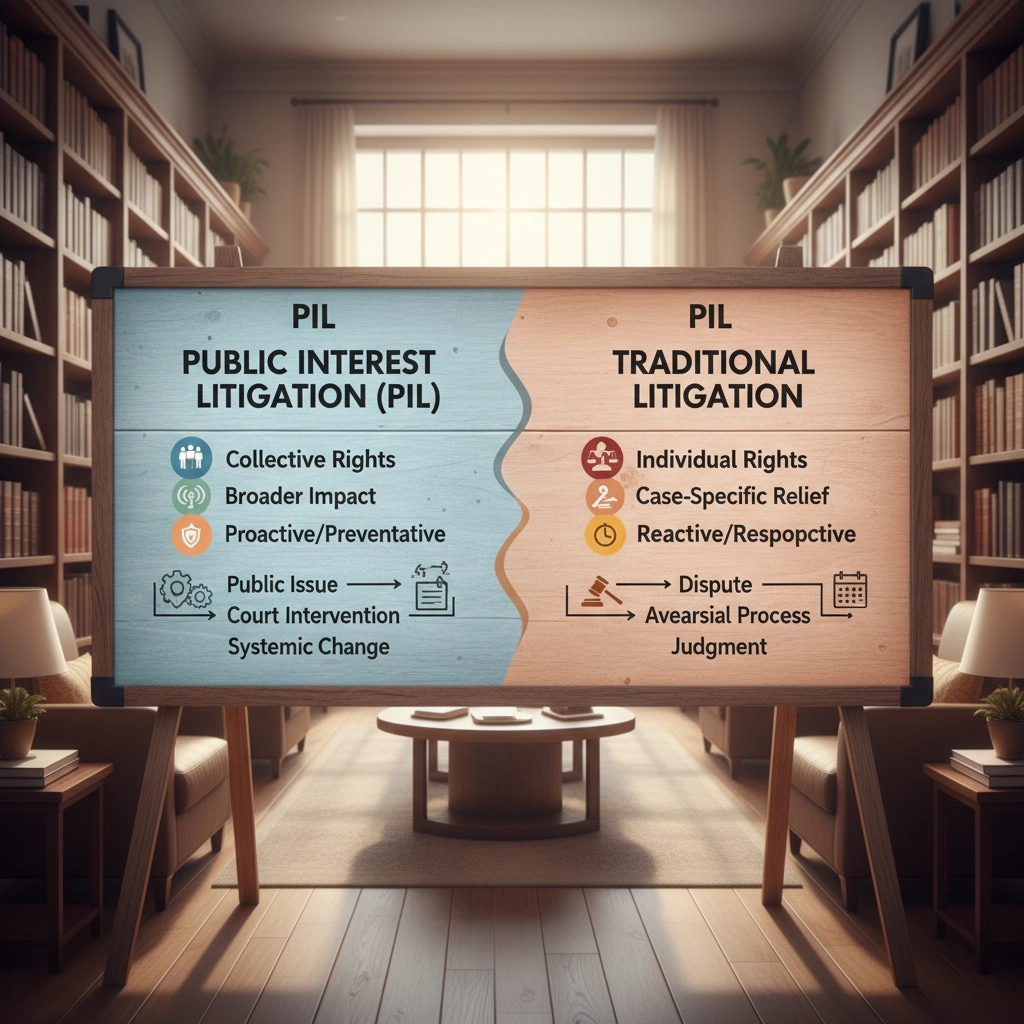
Traditional litigation, at its core, is a dispute resolution process between two or more private parties seeking legal remedies for specific grievances. This system is primarily designed to address individual rights and obligations, focusing on the harm suffered by the plaintiff and the corresponding liability of the defendant. The process typically involves filing a lawsuit, conducting discovery, presenting evidence in court, and ultimately obtaining a judgment or settlement. Traditional litigation operates on the principle of adversarial proceedings, where each party presents their case and the court acts as an impartial arbiter.
Scope and Purpose of PIL
Public Interest Litigation (PIL), in contrast, is a unique legal mechanism designed to address broader societal issues that affect the public at large. It allows individuals or organizations to bring matters of public concern before the courts, even if they are not directly affected by the issue. The primary purpose of PIL is to promote social justice, protect fundamental rights, and ensure accountability from the government and other public authorities. Unlike traditional litigation, PIL focuses on systemic problems and seeks remedies that benefit the entire community, rather than individual plaintiffs.
Key Differences in Approach
The fundamental difference between PIL and traditional litigation lies in their approach to legal issues. Traditional litigation is typically initiated by individuals or entities seeking redress for personal injuries or damages. The focus is on proving individual harm and obtaining compensation or specific performance. PIL, on the other hand, is initiated to address issues of public concern, such as environmental pollution, human rights violations, or corruption. The focus is on protecting the interests of the public and ensuring compliance with laws and constitutional principles. PIL often involves complex legal and factual issues, requiring the court to consider the broader social and economic context.
Standing to Sue
In traditional litigation, the plaintiff must have “standing” to sue, meaning they must have suffered a direct and concrete injury as a result of the defendant’s actions. This requirement ensures that the courts only hear cases involving real disputes between parties with a personal stake in the outcome. In PIL, the requirement of standing is relaxed, allowing individuals or organizations to bring matters of public concern before the court, even if they have not suffered direct personal injury. This relaxation of standing is essential for enabling citizens to challenge government actions or policies that harm the public interest.
Relief Sought
The type of relief sought in PIL and traditional litigation also differs significantly. In traditional litigation, the primary goal is to obtain monetary damages or specific performance to compensate the plaintiff for their losses. In PIL, the relief sought is typically broader and more geared towards systemic change. This may include orders directing the government to take specific actions, such as implementing new policies, enforcing existing laws, or cleaning up environmental pollution. The court may also issue guidelines or directives to prevent future violations of public interest.
Choosing the Right Avenue
When deciding whether to pursue PIL or traditional litigation, it is important to consider the nature of the issue and the desired outcome. If the issue involves a personal dispute between private parties and the goal is to obtain compensation for individual harm, traditional litigation is likely the appropriate avenue. If the issue involves a broader public concern and the goal is to promote social justice or protect fundamental rights, PIL may be the more effective option. It is also important to consider the legal and factual complexity of the issue, the availability of evidence, and the potential for success in court. Consulting with a lawyer experienced in both PIL and traditional litigation can help you make an informed decision.
Avenues for Legal Redress
Both PIL and traditional litigation play important roles in the Indian legal system, providing avenues for citizens to seek redress for grievances and to hold the government and other powerful actors accountable. Understanding the differences between these two forms of litigation is essential for choosing the right avenue for your cause and for effectively advocating for your rights and the interests of the public. By carefully considering the nature of the issue, the desired outcome, and the legal and factual context, you can determine which form of litigation is most likely to achieve your goals.